Introduction: Bad Credit? You’re Not Alone
Let’s get one thing straight—having bad credit doesn’t make you a bad person.
Maybe you missed some payments. Maybe you had a rough patch. Perhaps life has been too much for you lately. It happens.
If you’ve been turned down for loans or feel like you’ll never qualify for anything again, I’m here to tell you: You still have options.
In this blog, I’m going to break down how to get a loan with bad credit in 2025, in the simplest way possible—just like how I’d explain it to my cousin or a buddy over lunch.
What Does “Bad Credit” Even Mean?
When people talk about “bad credit,” they usually mean a credit score under 580 (based on the FICO scale). Here’s a quick cheat sheet:
| Credit Score | Rating |
|---|---|
| 800+ | Excellent |
| 740–799 | Very Good |
| 670–739 | Good |
| 580–669 | Fair |
| Below 580 | Poor / Bad |
If you’re in the “bad” zone, don’t worry—it doesn’t mean you’re stuck forever. But it does mean you should think more strategically.
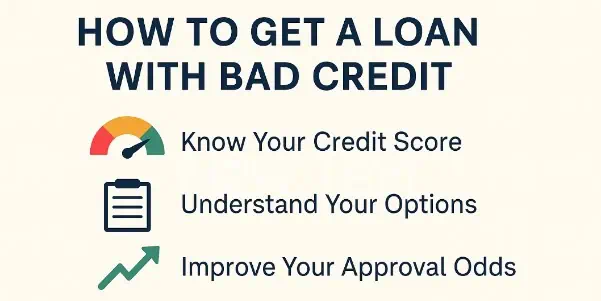
Step 1: Know Your Credit Score (Don’t Guess)
Before applying for any loan, know where you stand. Don’t just assume your score is bad because you got denied once.
Where to Check Your Score for Free:
- Credit Karma
- Credit Sesame
- Experian Free Credit Score
- Many banks and credit cards also offer it in-app.
Get your score and your full report. Sometimes, it’s better than you expect. And even if it is—knowing the exact number gives you power.
Step 2: Understand the Types of Loans Available with Bad Credit
Now that you know your credit score, let’s talk about what kind of loans you can actually get approved for.
Here are your top options:
✅ 1. Secured Personal Loans
These require collateral (like a car, savings account, or certificate of deposit). Because the lender has something to fall back on, they’re more likely to approve you.
- Pros: Easier approval
- Cons: Risk losing your asset if you can’t repay
- Where to find them: Credit unions, online lenders, or local banks
✅ 2. Unsecured Personal Loans for Bad Credit
These are traditional loans, but specifically for folks with bad credit. The catch? Higher interest rates.
- Pros: No collateral needed
- Cons: Expensive interest and fees
- Top lenders in 2025:
- Upstart
- OneMain Financial
- Avant
- LendingPoint
✅ 3. Payday Alternative Loans (PALs) – From Credit Unions
Way better than payday loans (which you should avoid—more on that later).
- Pros: Lower rates, no predatory terms
- Cons: Membership in the credit union is necessary
- Check with your nearby credit union to see if they provide PALs. It’s worth it.
✅ 4. Co-Signed Loans
If someone with better credit is willing to co-sign, your chances improve big time. But if you miss payments, their credit takes a hit too.
- Only go this route if you and the co-signer trust each other fully.
✅ 5. Peer-to-Peer Lending
Online platforms like LendingClub or Prosper connect you with individuals willing to lend money.
- Pros: More flexible approval criteria
- Cons: Still requires some decent credit and income
✅ 6. Auto Title Loans – Only in Emergencies
These let you borrow against your car title. But the interest rates are usually insane.
- Avoid unless it’s a real emergency and you’ve exhausted all other options.
Step 3: Improve Your Approval Odds (Even With Bad Credit)
Before applying, do these things to boost your chances—even if your score is low.
🔹 Show Proof of Income
Lenders want to know you can repay. Gather your:
- Pay stubs
- Bank statements
- Gig income proof (Uber, DoorDash, etc.)
- Benefits (Social Security, SSI, etc.)
🔹 Reduce Your Debt-to-Income Ratio (DTI)
You can compute your Debt-to-Income ratio by dividing your monthly debt expenses by your monthly income.
Try to keep it under 40% if possible.
- Example: If your monthly income is $2,000, your debt payments should be less than $800.
🔹 Add a Co-signer
We talked about this earlier. It can make a big difference.
🔹 Borrow a Smaller Amount
You don’t need to ask for $10,000. Try $500, $1,000, or whatever you need.
- Smaller loans = When the lender sees less risk, approval becomes more likely.
Step 4: Find Legit Lenders (And Avoid the Scammers)
When you’re desperate for a loan, scammers can smell it. Here’s how to avoid getting screwed:
✅ Early Signals You Should Take Seriously:
- They ask for an “upfront fee” – never legit.
- They guarantee approval – real lenders don’t.
- They don’t have a physical address or reviews.
- They pressure you to act fast.
✅ Stick with These Trusted Lenders:
| Lender | Type | Credit Score Needed | Loan Range |
|---|---|---|---|
| Upstart | Personal Loan | 580+ | $1,000–$50,000 |
| Avant | Personal Loan | 550+ | $2,000–$35,000 |
| OneMain | Secured or Unsecured | No minimum | $1,500–$20,000 |
| Credit Union | PAL | Varies | $200–$2,000 |
| LendingClub | Peer-to-Peer | 600+ | $1,000–$40,000 |
Step 5: Understand the Costs (APR Matters More Than You Think)
When you’ve got bad credit, you’ll probably pay more interest. But you still want the best deal possible.
Don’t just look at the monthly payment. Look at:
- APR covers not only interest but also any applicable charges.
- Total cost of the loan over time
- Early payment penalties
Example:
- $1,000 loan at 12% APR for 1 year = ~$67 interest
- Same loan at 35% APR = ~$195 interest
Big difference.
Step 6: Consider Credit Builder Loans
If you can wait a few months, credit builder loans are awesome.
How it works:
- You “borrow” money, but it goes into a savings account.
- You make monthly payments (like $50/month for 12 months).
- At the end, you get the money back—and better credit.
Great for: Rebuilding credit and getting approved for bigger loans later.
Best places to get one:
- Self (formerly Self Lender)
- Credit unions
- Some community banks
Step 7: What to Do If You’re Denied
Don’t panic. Don’t take it personally. Here’s your next move:
- Ask the lender why. They have to tell you under the Fair Credit Reporting Act.
- Check your credit report for errors. Dispute anything wrong.
- Apply with a credit union or local bank. They’re often more flexible.
- Use a credit builder tool.
- Try again in 3–6 months. After improving your score.
Step 8: Build Your Credit While You Repay
Getting a loan is just the start. Paying it back on time builds your score.
Here’s how to do it right:
- Set autopay so you never miss a payment.
- Don’t pay late—even once can hurt you.
- Use a credit monitoring tool like Credit Karma to track your score.
- Celebrate small wins. Every 10-point increase matters.
FAQs – Because You’re Not the Only One Asking
❓ Can I get a loan if I’m unemployed?
Yes, as long as you can verify other income streams—for example, unemployment benefits, Social Security, or gig earnings.
❓ Will applying hurt my credit?
Yes, but only a bit. Each hard inquiry might lower your score by a few points, but it won’t last long.
❓ What’s the best type of loan for bad credit?
Secured loans or credit union PALs are usually safest.
❓ Should I use payday loans?
No. Never. Seriously—avoid at all costs. They trap people in debt with 400%+ APRs.
❓ How fast can I fix my credit?
You can start seeing changes in 3–6 months with on-time payments and smart borrowing.
Final Words: You’ve Got More Options Than You Think
Having bad credit might feel like a curse, but it’s not permanent. And it doesn’t mean you’re out of options.
Whether you need $500 to fix your car or $5,000 for medical bills—there are legit, safe, and realistic ways to get a loan, even with bad credit.
Take small steps. Ask questions. Be smart.
You’re not broken. You’re just in a rebuild phase. And the good news? Rebuilding is totally doable.